Showing posts with label Mango. Show all posts

Thursday, October 26, 2017

AgroSol, Carbon Dioxide enhancement in Malaysia.

100% Natural, 100% Organic, 100% Bee Friendly!
Market development of Agrosol in Malaysia
Scientists warn of 'ecological Armageddon' after study shows flying insect numbers plummeting 75%
After 2 spray, new leafs.
Was searching for research papers for Carbon dioxide enhancement in Malaysia and couldn't find much on the internet. Had been checking with my associates and was told, yeah, people are using this in Malaysia.Maybe people that is using this is off line. Since getting on board to promote Agrosol, I need to create more awareness, especially on-line for a long term approach.

Had been relying on the supporting documents on AgroSol's web page and was happy to learn that they are 100% organic and natural. Latest certification is Bees friendly. The basic concept of spraying AgroSol, let it absorbed through the leafs and increase photosynthesis is simple enough and should work.

I went around the apartment spraying AgroSol on my own and the landscaping plants as a trial to see if it works. I find that some of the plants have this waxy leafs and the spray just kind of run off. I then remember that we have to add some surfactant / wetting agent.

Found 2 posting in Facebook, someone had tested it on Figs & Mango. It seems that these plants react differently to AgroSol. The Figs reacted to produce more buds. The Mango produce more leafs.

I bought a fig plant for testing of the AgroSol on fig. Am initiating some trials for Durian, Avocado, Turf grass and Rockmelon. Data should be available soon. Trying to contact more commercial people to do trial. Should you have interest, kindly contact me. Am trying to arrange close to Kuala Lumpur first due to logistic reasons.
Fig, transferred into recycle bag, filled with BioRichField & BioRichar
Testing different concentration on Turf grass.
Theoretically, it should work well. I have limit the variances to

Method of delivery, getting the AgroSol into the stomata.
My thinking is that delivery pressure and water droplet size affects delivery. Temperature and humidity level too. Adding a wetting agent helps and reduce the absorption time from 2 hours.Wetting / sticking agent help in rainfastness. Absorption is also enhanced by spraying to top & bottom side of the leaf. Different plants have different leaf physiology. Some have waxy coating, some have many small hairs, hindering delivery.
AgroSol's literature indicated delivery pressure of 3 to 4 bar and a nozzle diameter of 100 to 300 microns.

Concentration, different concentration for different plants.
AgroSol's literature indicated 1:66 to 1:266 and just a fine layer. My office suggested 1:400 to 1:600. I am still trying to find out what concentration work best for what plants. Optimizing the concentration, based on plants and stage of growth.

Start spraying
Frequency
AgroSol's literature indicates we can start spraying from the 2 leaves stage. At 10 to 14 days interval. I am in the opinion of optimizing frequency to the stage of growth & types of plants. My initial trials for rockmelon suggested that we need to increase frequency as the growth rate is rather fast (75 days cycle). For these fast growing plants, we can do more (photosynthesis) to more leaves in between the 14 days. I also feel that the current health condition prior to spraying also affects the out come. A plant in not good health shall need to recuperate first before new growth.

Expecting so data to be available in the coming weeks. Also expecting to do more trials on different plants. Stay tune.

#Agrosol #Organic #Natural #BeeFriendly 
Tested in Malaysia for #AvocadoFriendly #GrapeFriendly #DurianFriendly#MangoFriendly #RockmelonFriendly #PapayaFriendly #TurfFriendly #FigFriendly

Sunday, July 23, 2017

Mycorrhiza


Commercial Potent Grade Mycorrhiza
Waste from roots is food for mycorrhiza fungi, waste from mycorrhiza fungi is food for roots.


What Are Mycorrhiza?

“Myco” – “rhiza” literally means “fungus” – “root” and describes the mutually beneficial relationship between the plant and root fungus. These specialized fungi colonize plant roots and extend far into the soil. Mycorrhiza fungal filaments in the soil are truly extensions of root systems and are more effective in nutrient and water absorption than the roots themselves. More than 90 percent of plant species in natural areas form a symbiotic relationship with the beneficial mycorrhiza fungi.

Are They Important?

Mycorrhiza fungi increase the surface absorbing area of roots 100 to a 1,000 times, thereby greatly improving the ability of the plant to access soil resources. Several miles of fungal filaments can be present in less than a thimbleful of soil. Mycorrhiza fungi increase nutrient uptake not only by increasing the surface absorbing area of the roots, but also release powerful enzymes into the soil that dissolve hard-to-capture nutrients, such as organic nitrogen, phosphorus, iron and other “tightly bound” soil nutrients. This extraction process is particularly important in plant nutrition and explains why non-mycorrhiza plants require high levels of fertilization to maintain their health. Mycorrhiza fungi form an intricate web that captures and assimilates nutrients, conserving the nutrient capital in soils.
Do You Need Them?

Undisturbed soils are full of beneficial soil organisms including mycorrhiza fungi. Research indicates, however, many common practices can degrade the mycorrhizae-forming potential of soil. Tillage, removal of topsoil, erosion, site preparation, compaction, fumigation, invasion of weeds, and leaving soils fallow are some of the activities that can reduce or eliminate these beneficial soil fungi. Scientific studies indicate endo mycorrhiza fungal populations are slow to recolonize, unless there is close access to natural areas that can act as a source of mycorrhiza spores to repopulate the affected area. Reintroducing mycorrhiza fungi in areas where they have been lost can dramatically improve plant performance with less water and fertilizer and at a reduced cost.

Benefits of Mycopwer ™
On Plants

Produce more vigorous & healthy plants
Create better water & nutrient development
Increase plant root establishment & development
Increase Yield & Crop quality
Increase plant survival rate at seedling & transplanting
Optimizing fertilization use
Increase plant tolerance to soil salinity, disease & drought
   

On Soil Structure

Greater water infiltration & holding capacity
Prevent soil aggregation through hyphae networking
Better resistance to soil surface crusting, erosion & soil compaction
Increase permeability to air circulation, 
Increase beneficial microbial activity & nutrients cycling
Efficacy gain typically allows a reduction of 30% to 50% of conventional fertilizer input
Additional of AMF in ecological restoration project (Phytoremediation) has shown improvement on the physical & biological soil properties, structure, nutrients availability & organic matter.

Healthy & Bigger root mass = Higher Yield & Better Quality.


Monday, April 24, 2017

Agrosol For Trees

Is Agrosol suitable for trees?
Yes, Agrosol bring similar benefits to trees, the difference is the dosage and delivery. The basic is still the same.
AGROSOL is mixed with water and is applied onto the leaves surface via a fine spray mist. Since the discharge of CO2 takes place inside the leaf, this CO2 production does not generate a burden for the environment. In fact, quite the opposite of a burden is true: the plant converts the CO2 into glucose and proteins, discharges higher amounts of oxygen, and thus contributes toward the „green lung“ effect. Once AGROSOL has been sprayed as a fine mist onto the leaf surface, it enters the plant via the stomata. The minerals discharge CO2 inside the plant. This boosts the production of glucose and proteins and in turn, increases the amount of oxygen discharged into the environment. AGROSOL was even tested on Durian, Mango, Palm oil and others. I am still waiting for more details from the official channel. They even did a trial in Keningau, very close to my farm. Shall share more when I receive more details


Saturday, April 15, 2017

Agrosol

Photosynthesis.
Let us look into part of Photosynthesis. Photosynthesis is a process used by plants and other organisms to convert light energy into chemical energy that can later be released to fuel the organisms' activities (energy transformation). This chemical energy is stored in carbohydrate molecules, such as sugars, which are synthesized from carbon dioxide and water – hence the name photosynthesis.

Carbon dioxide is converted into sugars in a process called carbon fixation. Photosynthesis provides the energy in the form of free electrons that are used to split carbon from carbon dioxide that is then used to fix that carbon once again as carbohydrate. Carbon fixation is an endothermic redox reaction, so photosynthesis supplies the energy that drives both process. In general outline, photosynthesis is the opposite of cellular respiration, in which glucose and other compounds are oxidized to produce carbon dioxide and water, and to release chemical energy (an exothermic reaction) to drive the organism's metabolism. The two processes, reduction of carbon dioxide to carbohydrate and then later oxidation of the carbohydrate, are distinct: photosynthesis and cellular respiration take place through a different sequence of chemical reactions and in different cellular compartments.

Carbon dioxide levels and photorespiration
As carbon dioxide concentrations rise, the rate at which sugars are made by the light-independent reactions increases until limited by other factors. RuBisCO, the enzyme that captures carbon dioxide in the light-independent reactions, has a binding affinity for both carbon dioxide and oxygen. When the concentration of carbon dioxide is high, RuBisCO will fix carbon dioxide. However, if the carbon dioxide concentration is low, RuBisCO will bind oxygen instead of carbon dioxide. This process, called photorespiration, uses energy, but does not produce sugars.

Now what if we can create an environment whereby the carbon dioxide concentration is at consistenly maximum level? How would your plant react?

On december 21st 2007, company AGROsolution launched into one of the most important future markets.
Agriculture and Food!

It is 100% growth energy derived from natural minerals and without any chemical additives!

AGROSOL was developed to enable and promote healthy plant growth.

Plants are supplied from the outside with foil and soil fertilizers, providing for missing nutrients. As water becomes scarce and groundwater tables recede, supplying the plants with sufficient amounts of water is becoming increasingly difficult. As a consequence, artificial irrigation needs to be applied. 

These two factors (supply of nutrients and water from alternative sources) have been common knowledge for quite some time. However, what is still largely unknown (especially in open land cultivation) is CO2 fertilization.
Agrosol at Agronet Farms, Video 
Plants need a certain CO2 balance to achieve ideal growth. The optimum level for photosynthesis is a CO2 content between 0.1 and 1.0 percent by volume. Air has a CO2 content of only 0.03 % by volume. Therefore, plants are operating way below their full potential. 

The plant is literally „struggling for air“. This is where AGROSOL comes into play. 
AGROSOL is mixed with water and is applied onto the leaves surface via a fine spray mist. Since the discharge of CO2 takes place inside the leaf, this CO2 production does not generate a burden for the environment.

In fact, quite the opposite is true: the plant converts the CO2 into glucose and proteins, discharges higher amounts of oxygen, and thus contributes toward the „green lung“ effect. Once AGROSOL has been sprayed as a fine mist onto the leaf surface, it enters the plant via the stomata. The minerals discharge CO2 inside the plant. This boosts the production of glucose and proteins and in turn, increases the amount of oxygen discharged into the environment.
AGROSOL is mixed with water and sprayed onto the leaf surface in the form of a fine mist.


AGROSOL can be mixed with all commercially available fertilizers and plant protection materials.
Agrosol has distribution world wide. Their Asian Network manages 22 Countries, including Malaysia.
World class product! How can we acquire it? Well, MNC, world class products, this is only made available to the big boys, big corporate plantation in very high potent commercial scale volume and packing.

As I am back to being an entrepreneur, me and my friend is thinking, what about the Gardeners? Hobbyist? Enthusiast? Small & Mid size farmer? Wouldn't this product we great for us? We are organizing to make this available to this group of users. Do us a favor. Leave a comment so that we can gauge the response and anticipate the quantity of this first batch and method of delivery. This express of interest is strictly under no obligation.

Why are we doing this? The more users, the more oxygen! 

Sunday, June 29, 2014

Manggoes, Field Planting.

Did a field planting of our own grafted mangoes, mostly Manila Sweet and a couples of Apple Mangoes (MA 194), totaling about 24. About 4 Durians.

Check on them again. Most of them are growing. Had only 2 fatality.


We removed the grafting tapes so as it shall grow better. The fusion would had healed by now. Since we were at it, we put in some organic fertilizer. Arranging to manage the weeds.

This trip to Sabah, shall be adding another variety Nam Doc Mai aka Water Lily (MA 223).
 The Nam Doc Mai mango variety originated in Thailand and was registered in Malaysia as MA 223 in October 1990.  Nam Doc Mai is a popular mango variety and generally eaten when soft ripe. It is a major variety of commerce in Asia.

Sunday, June 22, 2014

Grafting Scissor.

Bought a Professional  Grafting Scissor. Had wanted to buy this but had been putting it off for a while.
Simple packaging.
It comes with 3 blades, Omega, V & U blade. The blade can be used on both ends making an effective of 6 blades.

Instruction is pretty simple,
Instruction given on the rear.
 Hold grafting stock in the grafting tool and squeezes the handle to make the cut, repeat this to cut the stem o the donor plant.
Slide the donor plant stem into the stock plant, matching the cut surfaces as closely as possible. If the stock and donor is of different size, match 1 side only.
Place sterilizing material around the join and bind with tape. The sterilizing material shall protect against bacterial & weather.
There is also a top scissor to use for pruning.

Blade sliding down onto the orange catch.

 This professional grafting scissor is effective for soft / green wood. It can not be used with hardwood. Effective grafting diameter is about 15mm.

It is designed to have a vertical sliding down cut.
Sturdy handle.

It is light weight as it's mostly plastic. The handle looks sturdy and comes with a lock. Looking forward to test this on the Jackfruit, Avocado, Mangoes & Figs. Wondering if this shall helps in my grafting.


Thursday, June 12, 2014

Mango, Mangifera indica.

Mango, we already have Manila Super Sweet and Apple Mango. Had some very tasty mango while in Koh Lanta, Thailand, bought at their local farmers' market. Inspiration came after eating these super sweet mangoes. Decided to strengthen our varieties,
Black Gold, Tong Dam.

Tong Dam, meaning Black Gold. In Malay it's called Emas Hitam.
The fruit is medium size, oval, stays green even when ripe, inside orange, early season. 
They are reports that Tong Dam taste as good as Harumanis, except that fruit is lighter.By staying green, I guess it should be less prone to pest attack.
Tong Dam are Bud grafted.

Chok Anan / Langkawi Mango (MA 224)
 Chok Anan mango is one of the most popular varieties grown in Malaysia & Thailand for local and export market. it is one of the sweetest mango with an average weight is 0.25 to 0.35 kilo per fruit. Another good characteristic is that it has thick skin, long shelf life and is resistant to attack of fruit fly. Having a thick skin also helps to reduce post harvest handling issues. Chok Anan mango can tolerate adverse weather conditions, even without spraying insecticide and fungicide the flowers will develop into quality fruits that is sweet that taste like honey. Another desirable characteristic of the Chok Anan is that it will bear fruit even during the rainy season.
Chok Anan / Langkawi Mango.

 Fruit is oblong, slightly fibrous, thin seed, thick flesh, sweet (16 ~ 17% brix), firm aromatic and a distinct coconut flavor.Skin is golden yellow when ripe.
 
Chok Anan leafs are broad, light yellowish green.

Honey Mango, Mangga Madu.

Honey Mango / Madu Anggur.
Leafs are narrow, dark green.
This is an Indonesian variety. 
Fruit is oblong, thick flesh, sweet and delicious. Average fruit weights 0.200 kg and 70 cm. Seeds is a good source of rootstock. Couldn't find much information on these.

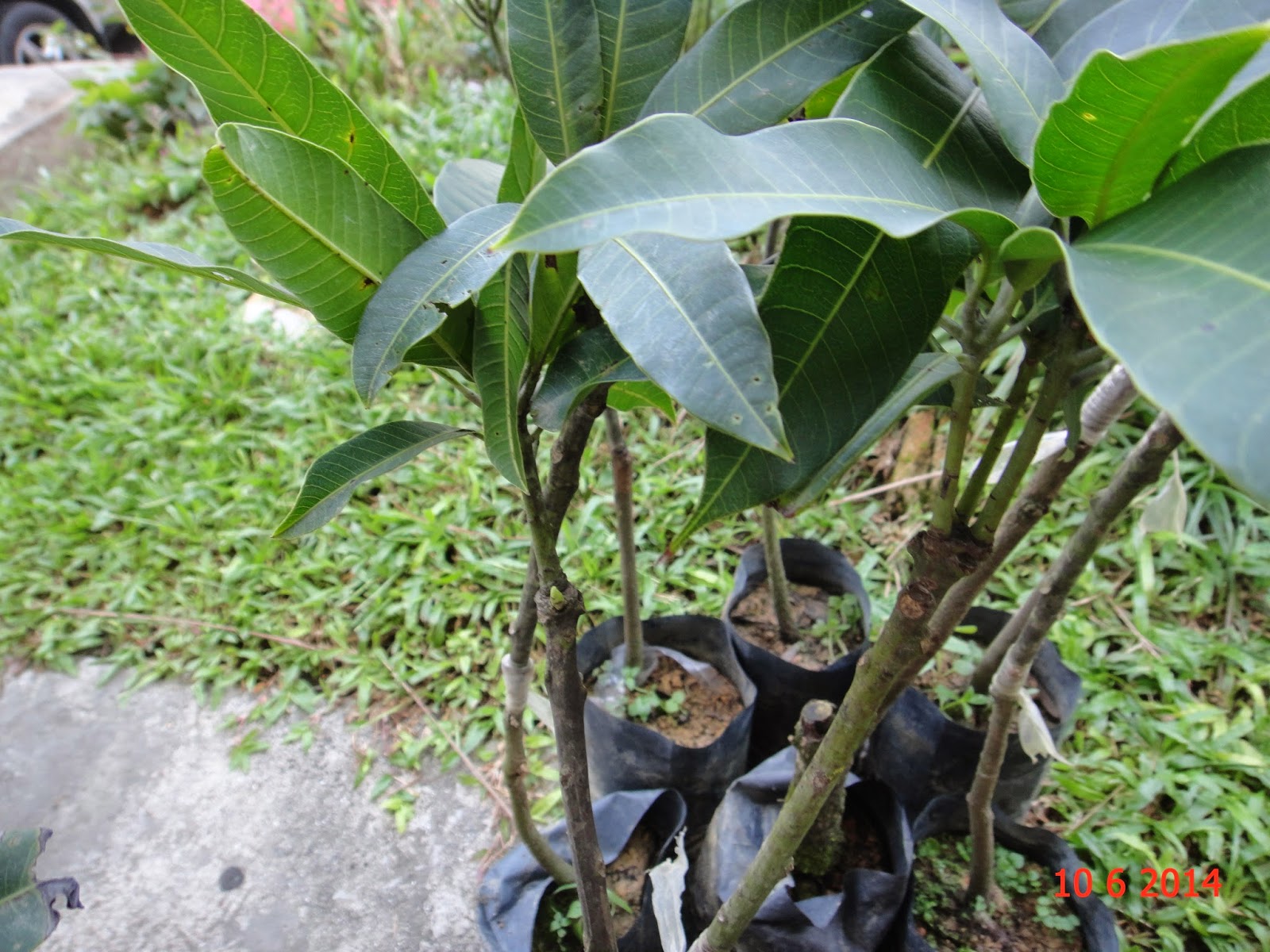
Mangoes prepared for relocation.
 
Arrived at destination. Transferring to poly bags soon.